One governed standard for health systems that adopt in silos.
Not a once-a-year audit scramble. Continuous monitoring, evidence collection, and remediation, delivered as an ongoing service, so you're never caught proving compliance from a standing start.
We have spent two decades delivering inside regulated and federal environments, so we know the terrain. Health systems adopt in silos: a headquarters on one EHR, affiliated community hospitals on another, provider offices on a third, each with its own security tools and its own AI bolted on vendor by vendor. The fragmentation is the hard part, and it is where most systems struggle. We built the platform around that reality.
SpecOps sits above all of it as the governance plane: one policy, one audit standard, one place where every AI action is re-decided and signed, on the stack you already own. A modular, cloud-based build, designed to start at one site and extend across the system.
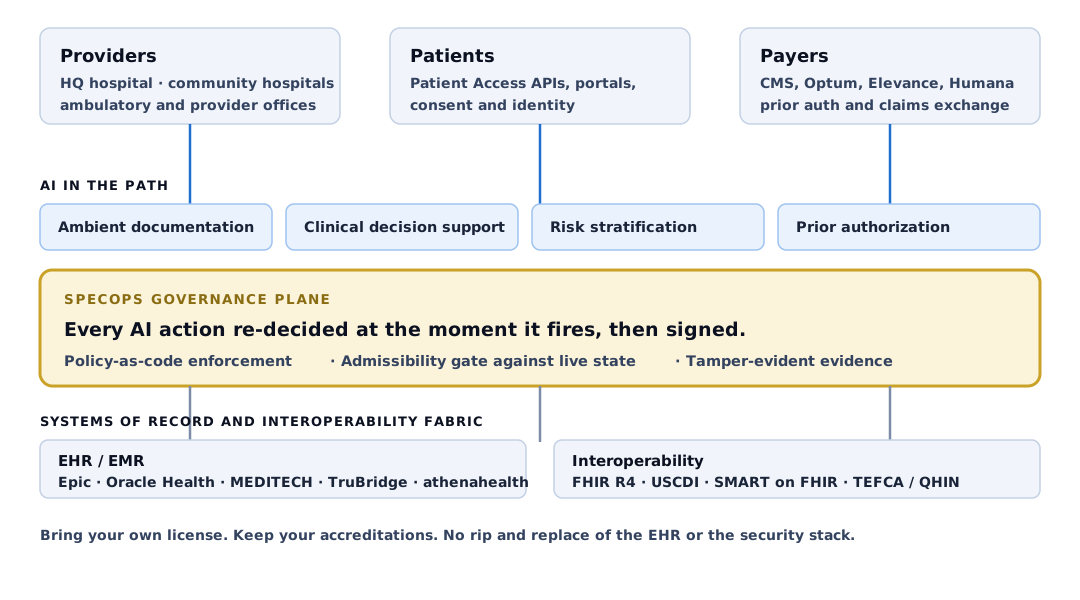
Patients, providers, payers, and records. One plane in the path.
Everyone in the ecosystem transacts through the same governed plane. The systems of record stay where they are. The AI stays where you chose it. SpecOps governs the actions that move between them.
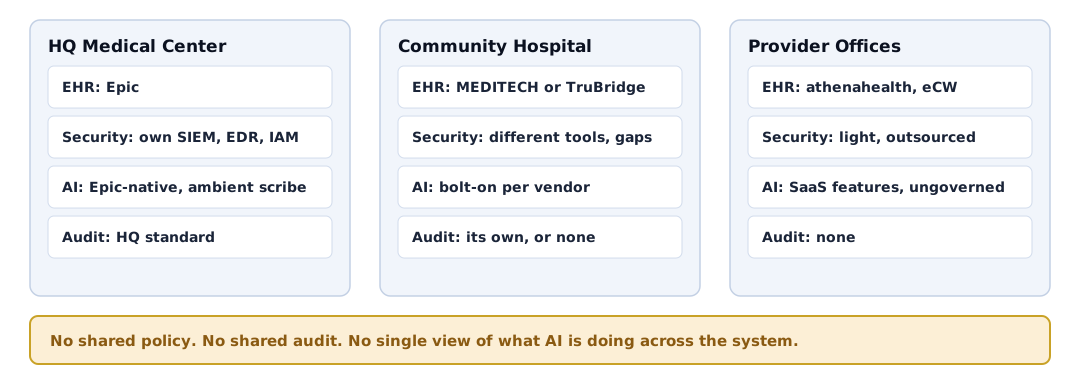
The problem is not the tools. It is that nothing governs across them.
A regional system grows by affiliation and acquisition. Each site kept its own EHR, its own security stack, and its own AI. The HQ has an audit standard. The affiliated sites have their own. No single plane sees, governs, or proves what AI is doing across the whole system.
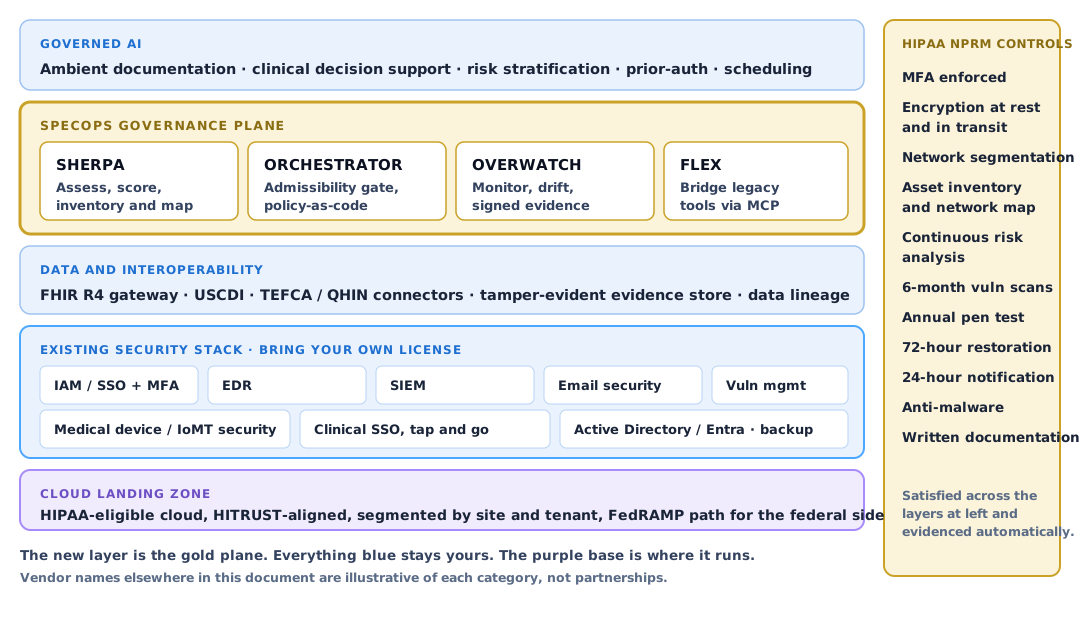
A cloud governance plane over the stack you already own.
SpecOps does not replace the EHR or the security tools. It adds the layer none of them provide: enforcement at the moment of action and signed evidence, deployed in a HIPAA-eligible cloud landing zone and wired to whatever each site already runs.
Five modules. Each one ships value on its own.
You do not buy the whole architecture at once. Each module is independently useful, maps to a proposed HIPAA requirement, and lands one of the use cases the system already cares about.
Discovery, asset inventory, network map
Scan each site's clinical and AI estate, produce the living technology asset inventory and the ePHI network map, and score governance readiness. This is the foundation every other module builds on.
Access governance at the action layer
Enforce MFA and single sign-on context on every AI action, so an action carries who authorized it. Works with the identity tools each site already runs rather than replacing them.
The AI governance and In-Flight Gate
Intercept each AI action, check it against live policy and live data, and let it proceed, route it to a clinician, or block it. The signed evidence package is produced as it runs.
Continuous monitoring and evidence
Watch for drift between approved policy, deployed behavior, and live state. Generate the scan-cadence and restoration evidence on the schedule auditors expect, not at document-recompilation time.
Interoperability and legacy bridge
Connect FHIR R4 and TEFCA exchange, and bridge the legacy MEDITECH, TruBridge, or office systems that cannot speak modern protocols, so a site joins the governed standard without a forklift migration.
The first site funds the foundation
The first site stands up the shared cloud foundation. Every site after inherits it, so per-site work is configuration plus that site's specific adapters. Cost and risk drop with each replication.
Pilot one site
A single community hospital or provider group. Modules 0 through 2.
Prove the audit
Show the signed evidence and the asset map a real audit would ask for.
Replicate to affiliates
Each new site inherits the foundation and loads its own adapters.
Standardize at HQ
One policy and one audit standard across every silo, governed centrally.
Proposed HIPAA controls, mapped to the build.
The HIPAA Security Rule overhaul is still a proposed rule, but it is where the sector is heading. Here is how the architecture answers each major proposed requirement, using the stack you already own plus the governance plane.
| Proposed requirement | How the architecture answers it | Where |
|---|---|---|
| Multi-factor authentication | Enforced on access and carried into the action context, so every governed AI action records the authenticated authority behind it. | MODULE 1 + BYOL IAM |
| Encryption at rest and in transit | Cloud landing zone enforces encryption by default; the evidence store and FHIR gateway encrypt in transit. | CLOUD ZONE |
| Network segmentation | Per-site and per-tenant segmentation in the landing zone; the governance plane sits at the boundary between AI and data. | CLOUD ZONE + INTEROPERABILITY |
| Asset inventory and network map | SHERPA produces and maintains the living technology asset inventory and the ePHI network map across every silo, reviewed on change. | MODULE 0 · SHERPA |
| Continuous risk analysis | OVERWATCH runs continuous monitoring rather than a point-in-time assessment, with risk surfaced as state changes. | MODULE 3 · OVERWATCH |
| Vulnerability scans and penetration testing | Scan-cadence evidence generated on schedule; testing results tracked to remediation with documentation retained. | MODULE 3 + BYOL vuln mgmt |
| 72-hour restoration, 24-hour notification | Backup and recovery evidence and contingency activation signals are captured as governed, time-stamped records. | MODULE 3 + BYOL backup |
| Written documentation | Policies, reviews, and decisions are produced as a byproduct of operation, not recompiled for an audit. | GOVERNANCE PLANE |
Mapping reflects the proposed rule (NPRM, January 6, 2025). Final requirements and timing may change. This is a positioning architecture, not a compliance opinion.
The platform is SpecOps. SDVOSB Consulting & Services powered by AgileLeap.AI. One governed engagement: the plane in the path, the modular rollout, and the people who stand it up and run it with you, starting at one site and scaling across the system.
Request a working session