Summary
Every merge should be assessed against the same rules, in the same words, before anyone reviews it. The machine does the assessment. A person decides.
Teams that ship with AI coding assistants now generate changes faster than people can read them. The usual response is to sample or skim, and that is how defects and architectural drift reach production.
A merge gate changes the economics of review. The routine clears on its own, people spend their attention on the exceptions, and every verdict lands in a record that shows what the change was held to. On our own platform, 85% of 1,991 gate evaluations needed no human review. The 294 that reached a person were the ones worth their time.
The Numbers
Our repository. Every gate evaluation, none sampled.
- 1,991 Evaluations assessed
- 1,697 Cleared automatically (85% needed no human review)
- 294 Reached a person
Counted from the decision record on September 27, 2026. Our measurement on our own repository, not an independent audit.
1. Generation Outran Review
Code review was designed for a pace that no longer exists. One engineer with an AI assistant can open more pull requests in a day than a reviewer can read carefully in a week. Three things follow.
- Attention goes to the wrong changes. The largest pull requests get the least scrutiny because they are too big to read. Our single biggest catch was one change that broke five distinct rules at once. That is exactly the change a reviewer skims.
- Advice is not a control. Review bots leave comments. Comments can be dismissed, and most of those tools cannot stop a merge.
- The evidence is thin. When an auditor asks what a change was held to, a green check only records that someone clicked a button.
Governance was never the thing slowing the build down. It is what makes going faster survivable.
2. What a Merge Gate Is
A merge gate sits between the pull request and the main branch, before a person opens the change. It applies a versioned set of rules the same way every time and returns one of three verdicts. It never guesses. When it cannot judge a change, it says so.
Verdicts
Passed: The change introduced nothing the rules prohibit. It moves on without taking anyone's time.
Held: The change introduced a finding. It goes back for correction, or to a person who decides.
Not evaluated: The check did not finish. No verdict is recorded, the reason is stated, and it is never counted as a pass.
Gauntlet is the merge gate inside SpecOps.AI. Its review covers six standards: code quality, architecture, security, production readiness, AI governance, and enterprise conformance. Each rule can run in advisory mode, where it reports, or enforcing mode, where it fails the build.
3. The Funnel
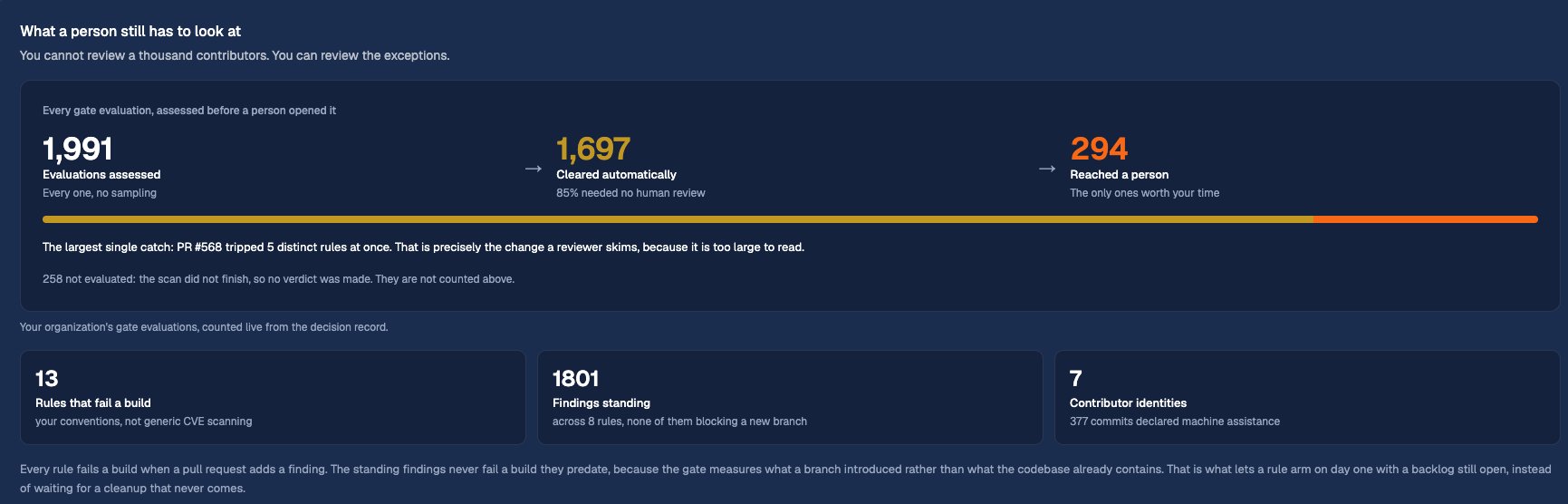
The funnel shows what the gate touches and what passes through. Of 1,991 evaluations, 1,697 cleared automatically and 294 reached a person. A separate 258 evaluations did not finish and were excluded entirely, not counted as a pass or a hold.
4. The Decision Record

Every verdict is committed to a hash-chained ledger. A change evaluated on day one can be audited on day 365 and will show the exact rules it was held to, whether it passed or was flagged, and what recommendations the tool made to the reviewer. The record is immutable, searchable, and exported with the change.
5. Principles of a Usable Gate
The gate must be on the critical path, not a suggestion.
The gate must not slow down the common case, so it cannot ask a person for every edge case. It must clear 85% of merges on its own.
The gate must be observable: every developer must know why their change was held, and know it before they open a PR.
The gate must be versioned: when a rule changes, the rule version changes with it. A change cannot claim it passed a rule that did not exist when it was proposed.
The gate must be auditable: every verdict and every override is recorded with a timestamp and the identity of the person who made it.
The gate must have teeth: if it can be bypassed, it will be bypassed.
6. Every Change Has a Declared Author

In the last 90 days: 1,645 commits across 7 git identities, 385,725 lines added. 377 of those commits declared AI assistance, 1,268 declared none. The record keeps the declaration per commit instead of averaging it into one figure, so an auditor can ask about any single change and get an answer, not an estimate.
7. Role Architecture
The gate works because three roles have clear responsibilities:
The Author writes and proposes a change. The gate tells them whether it will pass before they ask for review.
The Reviewer accepts the gate's verdict, overrides it with a signed reason, or sends it back for correction. The gate records every choice.
The Governance Lead owns the rule definitions and calibrates them as the codebase and the team evolve. When a rule produces only noise, it is adjusted or disabled.
Adoption: Four Steps
1. Measure the current state. Instrument the change log so you know how many changes hit each rule today. You cannot improve a rule you cannot measure.
2. Enable advisory mode. Wire the gate to report on every change but fail none of them. Let the data accumulate for two weeks.
3. Calibrate against your codebase. Use the report to see which rules are actually producing findings in your system. Disable rules that are all noise, adjust the severity of rules that matter.
4. Switch to enforcing mode. Once the noise is gone, flip the rules to fail the build. The gate now has teeth.
About These Numbers
This paper reports on SpecOps.AI itself, running Gauntlet on its own monorepo. The platform collects, evaluates and records every gate verdict. The data is live and auditable.
Gauntlet runs on GitHub via webhook, integrates with the merge queue, and returns a verdict in under 90 seconds.
The numbers reflect the actual experience of a two-person engineering team using AI coding assistants to ship a production platform. No tuning was done to make the numbers more impressive. The gate works because the rules were built to the codebase they govern, not borrowed from a generic checklist.